Questions, answered
The things people ask me before they ring.
Garden design is an unfamiliar thing to buy, and most of the useful information is locked up in people who do it for a living. Here is the bulk of it, free, whether or not you ever call me.
Before you start
Do I actually need a garden designer?
If the garden is broadly the right shape and you just want better borders, you may not — a planting plan on its own can transform a garden. Where design earns its money is anywhere there are levels to resolve, a layout that fights the house, a build of any real cost, or a space that has simply never worked and nobody can say why. The design fee is a fraction of the build cost, and it is the only stage where changing your mind is free.
What's the difference between a garden designer and a landscaper?
A designer works out what should be built and draws it so it can be priced and constructed accurately. A landscape contractor builds it. Keeping the two roles separate means someone is representing your interests when the quotes come in, and that decisions get made on a drawing board rather than improvised on site with a wacker plate running.
How do I brief a designer well?
Talk about verbs, not nouns. "We want to eat outside with eight people", "the children need somewhere to kick a ball", "I want to see something from the kitchen sink in February" are far more useful than "we want a modern garden". Photographs of gardens you dislike are as helpful as ones you love. And say your budget out loud — it is the single fastest way to get a design that can actually be built.
Will I need planning permission?
Usually not for planting and paving, but it can come into play with outbuildings, raised decking, boundary heights, anything in a conservation area or affecting a listed building, and work near a protected tree. It is one of the things I look at during the initial consultation, so it surfaces at the start rather than after something has been built.
Drawings and money
What is a measured survey and do I need one?
A topographical survey is a specialist measuring your plot accurately, including levels. On a flat, simple garden you can often manage without. On a sloping site, or where anything is being retained, stepped or drained, it is essential — every level on the drawings depends on it. It is a third-party cost, quoted separately, and I will always tell you if you can sensibly skip it.
Why do construction drawings matter so much?
Because they are the difference between three comparable quotes and three guesses. A specification pins down materials, finishes, edge details, drainage and build-ups, so every contractor prices the same garden and none of them has to invent a detail while standing in your border with a brick in his hand.
What will the build cost?
Honestly: it depends entirely on what the design involves, and anyone quoting a figure before seeing your garden is guessing. What I can do is tell you early whether the brief and the budget are in the same postcode, and shape the design around the answer instead of designing something lovely that you then cannot afford to build.
Can I build it in phases?
Yes, and plenty of people do. The trick is to design the whole garden first and then phase the build, so that the services, levels and drainage are right from the outset. Phasing a good masterplan is sensible. Building a garden in unplanned instalments is how you end up digging up a year-old terrace.
Planting
Why bother with a planting plan?
Because a nursery trolley on a Saturday morning is how most gardens end up as a collection of individual plants rather than a border. A planting plan sets out species, quantities, spacings and positions, works to your soil, aspect and exposure, and thinks about what the garden looks like in February as well as June. It also means the planting can be priced and sourced properly instead of bought at retail in a panic.
When is the best time to plant?
Autumn, for most things. The soil is still warm, the rain does the watering, and roots establish over winter so the plant is ready to go in spring. Spring planting works too but needs far more watering through its first summer. Container-grown stock can go in most of the year, but avoid the extremes — frozen ground and drought.
How long until it looks like the drawing?
Perennials and grasses will read properly by the end of their first full season and be at their best in year two or three. Shrubs take three to five years to do their job. Trees are a longer conversation. Good planting design plans for that — it should look deliberate from the first month and better every year, rather than looking finished on day one and tired by year three.
I want a low-maintenance garden. Is that a real thing?
Lower-maintenance, yes. No-maintenance, no — and the things usually sold as no-maintenance, such as artificial grass and sheets of gravel, tend to be the least pleasant to sit in. What genuinely reduces work is the right plant in the right place, dense planting that leaves weeds nowhere to go, generous beds rather than fiddly ones, and hard landscaping detailed so it does not collect leaves and weeds in every joint.
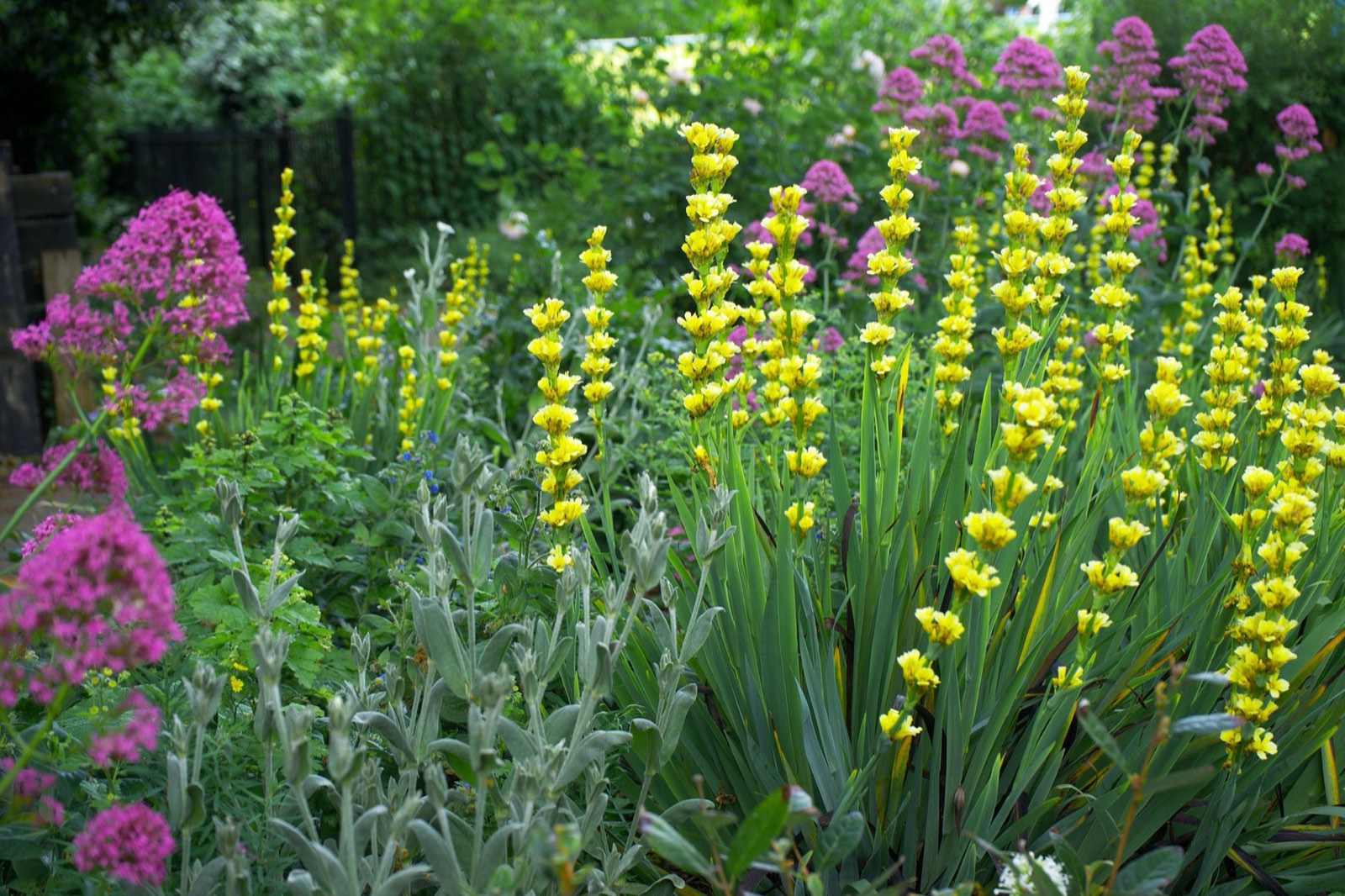
A note on planting
Structure first. Colour is the easy part.
The borders that look good all year are built in layers: evergreen structure and clipped shapes doing the work in winter; long-lived perennials and grasses over the top for summer and autumn; bulbs underneath for the weeks before anything else has woken up. Get those three layers right and the garden never has a genuinely dead month.
The other rule is repetition. A border with nine plants used three times each reads as a design. A border with twenty-seven different plants reads as a collection — and the eye cannot find anywhere to rest.
Got a question that isn't here?
Ask it. Jen answers her own phone and email, monday to friday, 9am – 5pm.